
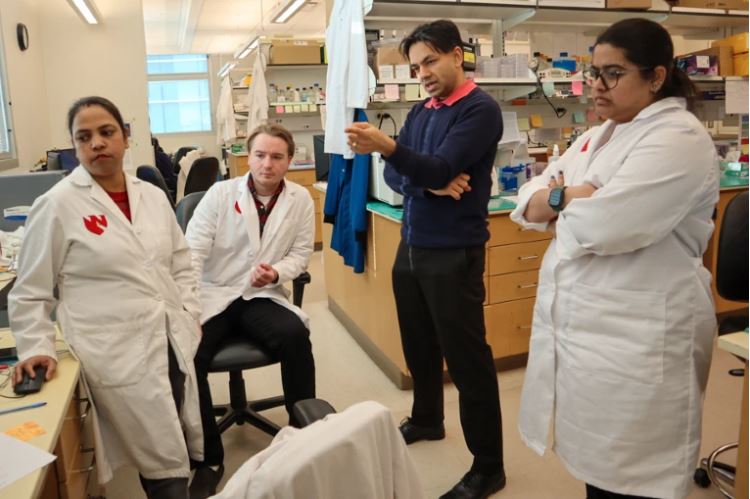
Caption: Sidharth Mahapatra, who established the NCBTC, holds brainstorming sessions to advance tumour research.Credit: UNMC-CHRI Nebraska
Originally published on June 24, 2024 via Nature. Produced by Nature Research Custom Media and Child Health Research Institute, UNMC and Children’s Nebraska
From tumour-homing nanoparticles to a potential medulloblastoma growth inhibitor, the Nebraska Children’s Brain Tumor Collaborative is trying to improve outcomes for children with high-risk central nervous system malignancies.
Paediatric neurosurgeon, Afshin Salehi, at the University of Nebraska Medical Center (UNMC) and Children’s Nebraska, regularly deals with hard-to-treat paediatric brain tumours. However, he describes diffuse intra pontine gliomas as the worst. “These tumours are located primarily in the midline of the brain and are often unresectable,” he explains. “Overall survival is nine to 14 months from the time of diagnosis with maximal treatment, and five-year survival is essentially zero.”
Alongside his clinical responsibilities, Salehi runs a basic science lab which is developing a new nanoparticle to enhance the efficacy of laser interstitial thermal therapy (LITT), a minimally invasive procedure that uses heat to destroy areas of abnormal cells. This ‘photothermal therapy’ nanoparticle has a tumour-homing capability. “It could be systemically injected to accumulate in paediatric high-grade glioma tumours to help remove the malignancy using LITT,” Salehi says. “These nanoparticles will be designed to absorb the laser wavelength, leading to a very customizable treatment zone. We want to treat the tumour without injuring nearby vital structures.”
Salehi believes this nanoparticle could progress to clinical trials fairly quickly, once optimized in animal models. “We currently have nothing else to offer these patients,” he says. “If this works, then many paediatric neurosurgeons will want to test it.”
Salehi has also teamed up with UNMC pharmaceutical scientist and professor, Aaron Mohs, to address the issue of suboptimal illumination during tumour surgery, particularly medulloblastoma. “By injecting Mohs’s new fluorescent nanoparticle, I could operate more effectively because the tumour should light up, compared to surrounding tissue, in a way that’s not possible now,” Salehi says.

Afshin Salehi is developing a nanoparticle with tumour-homing capabilities. Credit: UNMC-CHRI Nebraska
These collaborative research projects are a priority for Nebraska, which, according to the US Central Brain Tumor Registry, ranks seventh in the nation for paediatric brain tumours.
“Having a centre dedicated to researching these malignancies makes perfect sense for our catchment area,” says NCBTC medicinal chemist, Paul Trippier, an associate professor at UNMC. “Our multidisciplinary team works together to advance basic understanding of what brain tumours are, what causes them and what makes them progress.”
The rise of team science
While collaboration is an integral feature of today’s NCBTC, it took the vision and persistence of one physician-scientist to provide the spark that brought it to life. Sidharth Mahapatra, director of the NCBTC and paediatric intensivist at Children’s Nebraska, had never considered paediatric brain tumours as a research focus before his arrival there.
“I’m not sure I took care of a single brain tumour patient at my previous institution. Yet when I started at Children’s in 2015, I was taking care of 10-15 kids annually in the ICU after their brain tumour surgeries,” Mahapatra says. “I thought about Nebraska’s high rates, and how a study of these tumours would encompass cellular signaling, inflammation, neurobiology and critical care — fields that I was developing expertise in through my PhD and fellowship research. I realized that this was an ideal way to leverage the skills I had developed both at the bench and bedside to tackle a very serious problem in the children I cared for.”
Mahapatra started his work by obtaining paediatric brain tumour tissue samples from pathologists at Children’s and UNMC, creating the first paediatric brain tumour bank in Nebraska. The data he generated was added to the public domain (GSE148389) and provided transcriptomic and clinical data specifically on medulloblastomas diagnosed and treated at the two institutions. With no dedicated infrastructure in place, he had to do all the heavy lifting himself.
“In the thick of the pandemic, when many of us felt isolated and separated from our research, I realized that I couldn’t move the field fast enough alone,” Mahapatra says. He approached five colleagues on campus — all studying different aspects of paediatric brain tumours — to explore ways in which they could collaborate on innovative research projects.
As a result, in late 2020, Mahapatra established the NCBTC. Receiving joint funding from the state of Nebraska and Team Jack Foundation, Mahapatra is now working on a Pediatric Brain Tumor Core Facility that specializes in animal modelling and tumour banking, to provide internal researchers access to these resources. “When a new researcher joins us, we can now offer easy access to the patient database, tissue samples and established animal models,” he says.
With the infrastructure in place, collaboration between researchers was flourishing.
Mahapatra’s research identified a list of onco-proteins for potential inhibition to halt medulloblastoma growth, but he lacked inhibitor design expertise. He approached cancer drug discovery specialist, Trippier, to collaborate. Following Trippier’s evaluation of each compound, the pair chose one to pursue: B7-H3, an immune checkpoint molecule in paediatric medulloblastomas that plays a role in tumour immune evasion. “We’re optimizing several lead compounds targeting this immune checkpoint inhibitor as effective killers of medulloblastoma cells that can get into the brain of mice, without killing normal cells,” Trippier says. “This process has taken about two years, compared to the five or six years it would take at many other institutions.”
For Salehi, who received bench science training before attending medical school, collaboration between scientists and physicians is essential for making progress in such a challenging malignancy. “If an MD and a basic scientist are talking all the time, which we do here through a coached process with regular meetings and brainstorming sessions, we hear many creative solutions,” he says. “We all find that our counterparts often provide unexpected insights based on their specific expertise.”
Mahapatra agrees that the NCBTC is making great strides toward its goal of understanding and combatting paediatric brain tumours in Nebraska and beyond. “My intention was for the NCBTC to serve not only me or my direct collaborators, but to also help those connected to my collaborators,” he says. “While we share a strong emphasis on publishing and creating innovative preclinical models to advance our science, the ultimate goal remains the same: to help children who continue to suffer devastating outcomes from brain tumours.”